Monday, April 25, 2011

Week 36: EASTER in Argentina!!!

Happy Easter!!  Felices Pascuas!! 

It was fun being apart of Easter in Argentina.  The Easter holiday in the Argentine Lutheran Church is celebrated pretty much the same as in the US.  We celebrated Semana Santa (Holy Week) with a service every night.  Jueves Santo (Maundy Thursday) we striped the altar and left the service in silence.  Viernes Santo (Good Friday) our pastor presented an interesting powerpoint relating Good Friday to Latin American Struggles (and to liberation theology).

Pastor Angel presenting his power point
The alter draped in black

On Sabado Santo (Saturday before Easter Sunday) we had a program for the children all day.  I was the head of arts and crafts and we made rainbow crosses that my parents had brought as gifts from my home congregation.  The kids loved the project and were really excited to bring them home.  I worked with the older kids and the preschool-2nd grade kids got to make homemade chocolate bonbons to eat and to bring home.  All ages also got to paint eggs and work on little egg baskets for the Easter Sunday breakfast.    

One of the girls from church working on her cross
Other children working carefully on their rainbow crosses
 We also had a snack together before the kids left.  We ate ham sandwiches, sweet popcorn, and rosca de Pascua (special Easter bread).  We all had a good time chatting and snacking.  After the projects where finished we started setting up of the Easter Sunday breakfast.
 
Cristina with the yummy sweet popcorn she made.  It is really tasty!
Close up of the eggs that were painted by the children
The little egg holders that the kids made as table decorations for the Easter breakfast
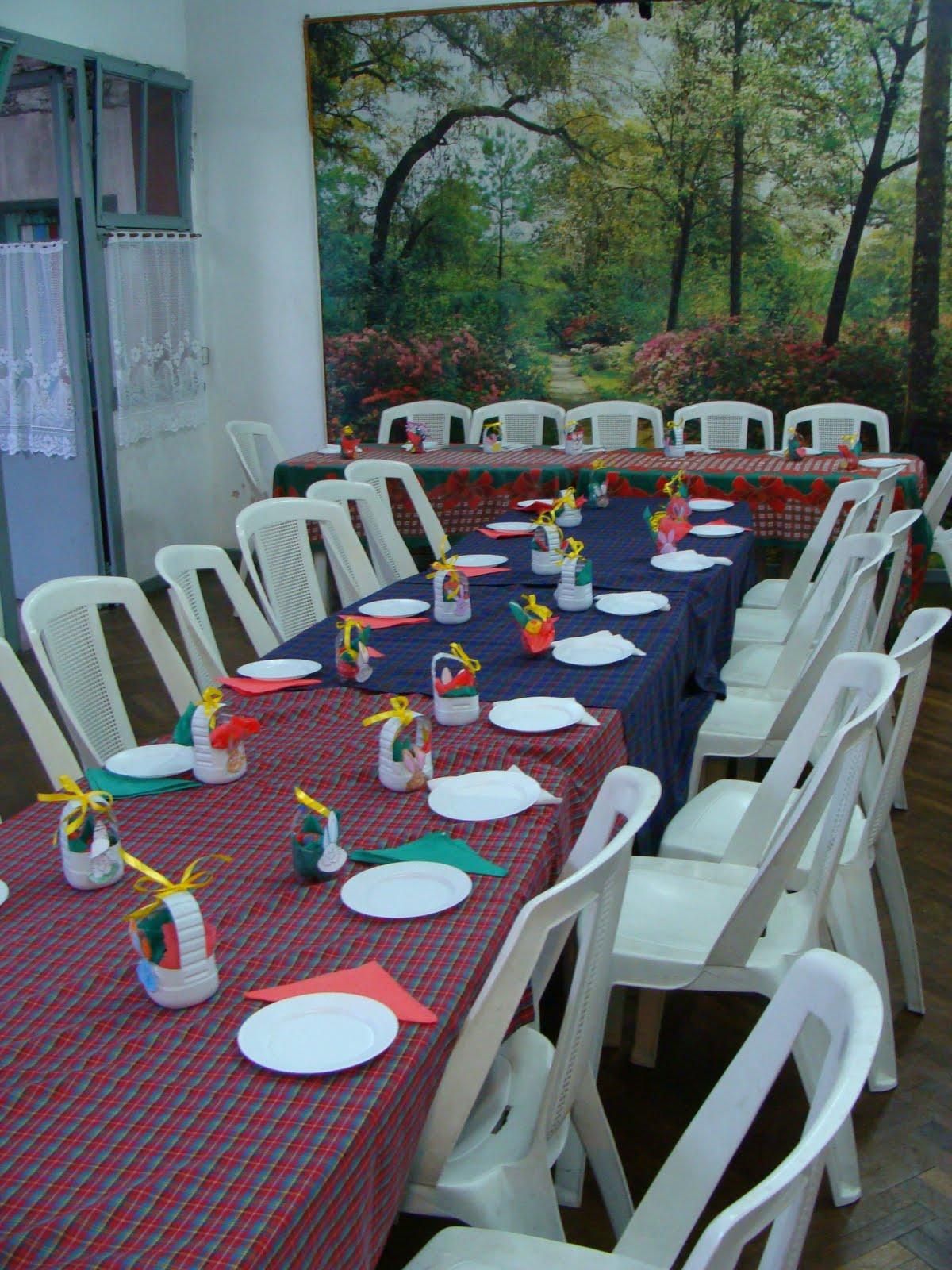
The tables all set and ready the night before Easter Sunday
Elsa (woman from church) and Chabela (pastor's wife) cutting the rosca de pascua bread for the Easter Sunday breakfast.  The rosca de pascua is a traditional bread eaten on Easter that is a sweet bread painted with eggs and them drizzled with sweets such as chocolate or frosting. 
Easter Sunday Breakfast
On Easter Sunday at 10am we had our special Easter breakfast!  It was a great turnout...I do not think I have seen so many people in church ever.  We enjoyed tea, coffee, rosca de pascua, cookies, cheese bread, lemon bread, and Birthday cakes!  The kids got to have chocolate milk and soda...lucky I was sitting at the kids tables and got to drink a bit of chocolate milk myself :)  

Singing Happy Birthday to some of this month's Birthday kids
After breakfast at 11am we all headed into the chapel for Easter Sunday service.  There were so many people that we had to bring in extra seats!

The lovely Easter altar with flowers from the church garden
Pastor Angel reading the Easter Sunday gospel
After the service and I got to hand out chocolate Easter eggs to all the kids.  Then after helping clean up the breakfast dishes and tables I headed over to Kate (my country coordinator), David and family's house for Easter lunch.  The are from the USA and are missionaries with the ELCA.  David grilled meat outside over a fire on a grill (Argentine custom known as an asado) and we enjoyed stake that almost melted in your mouth.  Argentine meat is really tasty...no wonder it is known all over the world for being so yummy!  

Kate had recently been in the United States for her job and brought back funfetti cake for us to bake and Easter candy for the kids!  They were nice enough to share with me...man I forgot how good sweet tarts taste!  Before lunch I got to color eggs with Matt and Emily.  After lunch we went over to a local plaza and played American football.  The park was packed but I am pretty sure we were the only people there playing American football :)  It was fun spending time with Kate and her family for Easter...it made the holiday seem more homey. 

(order L to R) Matt, me and Emily painting Easter eggs
Our splendid colorful eggs :)

Tuesday, April 19, 2011

Week 35: "Freedom" by Amos Lee

I posted the lyrics to Amos Lee's song called "Freedom" becasue I wanted to share it with you all.  I dig the song and its important meaning.  I am not sure if most of you know this but music impacts me a great deal and it is pivotal part of my daily life.  I almost constantly have music playing becasue I enjoy singing along and dancing.  Also, I identify with lyrics in songs helping me get through certain emotions and feelings.  When I'm happy I belt out a little "Here Comes the Sun" from the magical Beatles or any of the other classic oldies tunes.  When I'm working out I listen to face paced dance music to help motivate me.  When I dine I break out the Frank Sinatra or a little swing.  When I am angry I sometimes play Lady Gaga, Beyonce or Queen.  When I want to relax I play Enya, Debussy, Mozart or Bach.  And for most other emotions I have specific songs that I enjoy listening to.  Anyways enough about me, here are the lyrics...enjoy :)  

"Freedom"

Don't wanna be a martyr in this war
Don't wanna hear the same excuses anymore
That everything's a threat
And it's only gonna get worse if we let it

Don't wanna blame the rich for what they got
Don't point a finger at the poor for what they have not
Though the politician and the priest
Live in the belly of the beast because we fed it

Freedom is seldom found
By beating someone to the ground
Telling them how everything is gonna be now, yeah

Now if the tables were turned tell me how you would feel
Somebody busted up into your house telling you to stay still
While the leaders will deny defeat
Innocents they testify by dying in the street

Freedom is seldom found
By beating someone to the ground
Telling them how everything is gonna be now

Freedom is seldom found
By beating someone to the ground
Telling them how everything is gonna be now

Monday, April 18, 2011

Week 35: April Newsletter: Drinking up the Argentine Culture


A group of people drinking mate
After being in Argentina for over 8 months I have gotten to know a lot about Argentina’s national beverage known as mate (mah-tay). At first this strange tea-like drink seemed so unusual and it scared me a little because we really do not have anything like it in the United States. I had no idea about the specific etiquette involved and I did not want to offend anyone. Now, after being here for almost a year, I see it as an endearing part of the Argentine culture and it is a custom that I will miss when I return to the United States. Mate and its traditions reveal a great deal about the Argentine culture; but before I go into all of that I want to share a bit of basic information about this mysterious drink known as mate.

Mate herb is brewed from the leaves of an evergreen tree that is native to northeastern Argentina, Brazil and Paraguay. The herb contains mateine, a gentler stimulant than the closely related caffeine but without the nasty side effects. The herb is a tonic and a digestive agent, and by dulling the appetite can help you lose weight. As with other brewed herbs, yerba mate leaves are dried, chopped, and ground into a powdery mixture called yerba (pronounced zsheer-buh by Argentines).

Yerba (mate herb)
The traditional drinking vessel is known as the mate (pictured below), a type of hollowed-out gourd originally native to the region. Many of these mate gourds are works of art. They are sometimes carved and/or painted, and often made of wood, clay or metal, though enthusiasts claim gourds add extra flavor and are the best material for mates.


Another essential tool needed is the bombilla (bom-bee-zshuh)(pictured below), originally a reed or a stick of bamboo. Today most are made out of silver, aluminum or tin. The bombilla acts as both a straw and a sieve. The end from which you drink is flattened and the submerged end is flared, with small holes or slots that allow the brewed liquid in, but block the chunky matter that makes up much of the mixture.

Typical bombilla
Mate is traditionally drunk in a particular social setting, such as family gatherings or with friends. After preparing the mate gourd with yerba (mate herb) and thrusting the bombilla (metal straw) into the yerba, the server (cebador in Spanish) trickles very hot, not boiling, water down the side of the bombilla. Generally the cebador will start a new infusion and then take the first drink. The other people in the circle consider this an act of kindness, because usually the first serving is considered the worst.

Next, the cebador passes the mate clockwise. Each drinker in the circle must drain the mate through the same bombilla, without moving the straw, and by sipping gently and quickly before handing it back to the cebador. Slurping, surprisingly, is not considered rude and occurs often. This rotation continues until the yerba has lost its flavor or everyone has had enough. Saying “gracias” means that you have had enough, and the cebador will pass to someone else when your turn comes around again.

Ok so now you all know how to survive in a group that is drinking mate. What an interesting tradition! There are some people here who almost only have the use of one hand because the other hand always has a mate in it. I have seen mate in some very surprising places. People here REALLY love their mate. I have seem people drinking it on mopeds and in cars while driving, while walking down the street, during classes and meetings, while on a bus, while hiking, and while in plazas even when outside temperatures are insanely high and you would think that no one would be able to stand drinking a hot beverage. Basically any scenario you can imagine I am sure someone here has done it while drinking mate.

Those who share the mate join in a kind of bond of total acceptance and friendship. Mate is more than just a drink. The magic of Mate is that the drinkers are sharing in community. As everyone sits in the circle they chat about anything and everything sometimes for hours and hours. At first, being a person from the sometimes hygiene obsessed United States, it was difficult to drink out of the same straw as everyone, sometimes even people I hardly knew. Now, I feel lucky to be asked to share a mate with someone. It is a simple way of welcoming, offering friendship and even a listening ear. Truth be told, I do not enjoy the taste of mate due to its bitter flavor; but being allowed to enter into the circle of trust with others makes me feel honored and helps me to enjoy it more and more. I have also been informed that most Argentines do not even enjoy the taste of mate but it is so infused into their culture that people drink it everyday nonetheless.

My favorite mate moment was when I was visiting Krystal, another YAGM volunteer, in Bariloche located in Patagonia. I went hiking at cerro llao llao with Krystal, Emily (the YAGM volunteer in La Plata) and Vicky, another girl who lives in La Plata with Emily during the school year but was at home in Bariloche for the summer. Vicky suggested that we bring a thermos of water and mate to drink on our hike. I would have never thought of bring mate on a hike but it turned out to be really great having it along. At the top of the mountain we looked out at the spectacular view and shared a mate. Not only was it nice to drink a hot beverage but also it was fun resting and chatting with friends for a while before we started out descent.

Enjoying mate on top of the llao llao mountain
The custom of drinking mate reflects the nature of most Argentine people. They are warmhearted, caring, sharing, and tranquil. One thing I have learned a lot about here is the idea of “being” and just enjoying what you are doing when you are doing it. Before coming here I sometimes would be so busy that I was constantly focusing on what was coming next or what I needed to get done instead of taking pleasure in what was going on at that exact moment. Here I have learned a bit of how to throw the ol’ schedule out the window. Argentines are not continuously focused on being on time or thinking that they need to be working toward a specific goal. They know how to just “be.”

This Argentine culture knows how to sit, share, and enjoy the company of others. Spending time sharing mate and chatting with friends is not seen as a waste of time but a normal part of their daily living. I like that and I wish our United States culture had such an interesting and simple way of sharing in community with others. I plan to bring all the mate essentials back with me from Argentina so everyone can try it!

This month’s quotes for thought:

“You can’t change the past, but you sure can ruin the present by worrying over the future.” Kennons Wilson

“All journeys of soul lead us to the smallest moment of the most ordinary day.” Sue Monk Kidd, The Dance of the Dissident Daughter

This moth’s scripture quote for thought:

Importance of sharing in community:
“Just as each of us has one body with many members, and these members do not all have the same function, so in Christ we who are many form one body, and each member belongs to all the others. We have different gifts, according to the grace given us.” Romans 12: 4-6

Saturday, March 12, 2011

Week 29: March Newsletter: Waste Land


Today I came across a documentary film that I feel really ties together with the type of situation and people I am working with here in Argentina. This movie inspired me and reminded me that one of the greatest ways of fighting injustice is through knowledge and education. Writing these monthly newsletters and blog entries are so important to me because sharing my story and realizations with you all is one of the only ways I can actually help the people I am working with this year as well as others like them. So far in my living life in the US, I find that sometimes I get caught up in my own life and daily schedule. This makes it easy to live in my own personal bubble where I do not know what is happening in other parts of the world and where I find myself not helping those in need in any way.

This year in Argentina, a zeal has grown stronger in me. It was always present but being here has fanned the small flames within me making a well-built fire. I am more passionate about changing poverty, inequality, child abuse, and environmental degradation. In the United States there is a common misperception that the causes of poverty are highly related to personal factors such as a lack in work ethic. I think that such a belief discounts the many structural factors that prevent people from excelling in American society. Factors that I think cause and perpetuate poverty include unequal access to education, a deficit of jobs, broken and/or dysfunctional families, health issues (including mental illness), discrimination, and language barriers. In order to truly address poverty in the United States attention to these structural factors is essential.


This year I have begun to put my dedication to work for social justice into action by working with marginalized children and youth in Argentina. However, one of the main things that I have learned is how complex and arduous it is to change such long-standing problems such as poverty and inequality. Often I feel that there is not much I can do. What can I do without inadvertently harming the person I intend to help? What long-term solutions might there be for problems like poverty? These are just a few of the questions I have been asking myself so far this year.

While many of my questions remain unanswered, I have learned that the injustice these children face every day takes a lot of time and effort to heal. Change does not appear over night as I might wish it could. This has been difficult for me to accept because it seems absurd that anyone on this plentiful earth should be starving. But this absurdity also makes it even more important to fight to end social injustice. For now I am giving them the only gifts I can, which are love and attention. I let the children know every day in whatever way I can that they are special, unique and important. I do this by motivating them to play soccer, giving individual attention to children by playing games, drawing, or just talking, helping prepare meals to serve to the children, and planning arts and crafts projects that the children can take home. Overall I try to make the children feel good about them selves in everything they do.


While in Argentina, I am realizing that I posses a deeper passion for fighting injustice than I initially imagined. Before my experiences here it was easy to get caught up in my own life and to forget that others were suffering. Now, after recognizing the empathy and compassion I feel for these underprivileged people and their undeserved situations I have decided that I cannot go on living my life without fighting against social injustice. In my eyes these people deserve a better life and I am willing to use my gifts and talents to help them in any way I can.


So after all that being said I recommend to you all the documentary call Waste Land. This movie is relates a lot to the community I am now a part of here in Argentina. Here in Buenos Aires there are people called “cartoneros” (similar to the “catadores” in the movie) who go around digging through people’s trash and collect objects to recycle like cardboard (cartón in Spanish). Like the people in the movie, they get money for collecting and this is how they make their living. Similar to Rio de Janeiro, Brazil, Buenos Aires, Argentina does not have an organized recycling system.


Cartonero in Buenos Aires
The community center I am working at is located on land that used to be a garbage dump. Now the garbage dump is has moved farther back making this land available for living. In this area there is no clean water and they have to bring in water. Sickness is still a problem because the earth is still contaminated meaning digging in a garden could be toxic. I have never been to the garbage dump in the community so I am not sure how closely the documentary relates to that area. I think that the dump in Rio de Janeiro is probably a worse scenario but the situation here is probably not that far off.

Here is a Synopsis of the film that I got from the movie’s website which I recommend that you all check out. If you can't get a hold of the movie it has pictures and much more about the project (http://www.wastelandmovie.com/index.html):

Filmed over nearly three years, WASTE LAND follows renowned artist Vik Muniz as he journeys from his home base in Brooklyn to his native Brazil and the world's largest garbage dump, Jardim Gramacho, located on the outskirts of Rio de Janeiro. There he photographs an eclectic band of “catadores”—self-designated pickers of recyclable materials. Muniz’s initial objective was to “paint” the catadores with garbage. However, his collaboration with these inspiring characters as they recreate photographic images of themselves out of garbage reveals both the dignity and despair of the catadores as they begin to re-imagine their lives. Director Lucy Walker (DEVIL’S PLAYGROUND, BLINDSIGHT and COUNTDOWN TO ZERO) and co-directors João Jardim and Karen Harley have great access to the entire process and, in the end, offer stirring evidence of the transformative power of art and the alchemy of the human spirit.


An example of one of the pieces from Vik Muniz's series made from garbage
Image from the garbage dump in Brazil

Tuesday, March 1, 2011

Week 28: February Newsletter: Living Simply and Sustainably

I try to reduce my ecological footprint as much as possible by recycling, reusing, reducing water usage, eating locally, and saving energy. I am not an extravagant spender and come from a middle class family where I have always had to work for things. As a young adult out of college, I have a limited income and try to save money and spend it wisely.

In Argentina, living simply and sustainably is a part of the YAGM program philosophy. We get paid enough to cover daily living expenses like food and simple necessities. Living in such an economical way has taught me how to work and live carefully on a budget. I closely keep track of what I spend and try to find ways to save money. One example of this is that I cook most of my meals and seldom go out to eat. I have found that little adjustments like this are useful ways to live on a budget.

This year I have been working in Argentina with an underprivileged community that lives mainly on a garbage dump. The experiences I have had here have shown me that living simply can also be a form of service to others. Gandhi once said, “live simply, that others may simply live” and I agree one hundred percent. I have begun to see what my comforts can cost others and I find it difficult to be at peace with consumer-based living when I know others are struggling just to find food to feed their families. Therefore it is imperative to live simply and sustainably so others can share in the world’s resources. It is also important to live in this way so that future generations can enjoy a healthy life and the richness of this earth.

Living simply and sustainably has become a spiritual practice as well as a socioeconomic statement. I find that having less and being more aware of my impact on this earth brings me nearer to God. I see the earth as a gift from God and spending time in nature is one of the ways I feel closest to God. Once we accept that the earth is part of God’s creation, like ourselves, it becomes evident that we are not superior to nature but a connected part of it. This means that the rest of creation is here to be interconnected to us, not controlled.

Consequently, living simply and sustainably is deeply tied to my faith and is a philosophy I promote. Living simply and sustainably has become a part of who I am. I have realized that I would like to more deeply engage in simple and sustainable living by continuing to uphold my commitment to sustainability, learning new ways to live more simply, and sharing ideas of simple and sustainable living with other.

Notable facts:

United States Americans constitute 5% of the world's population but consume 24% of the world's energy.

United States Americans throw out 200,000 tons of edible food daily.

Less than 1% of the world’s fresh water (or about 0.007% of all water on earth) is readily accessible for direct human use.

884 million people lack access to safe water supplies; approximately one in eight people.

A United States American taking a five-minute shower uses more water than a typical person in a developing country slum uses in a whole day.

Suggested documentaries relating to this topic:


The Eleventh Hour
Food Inc.
Blue Gold: World Water Wars

This month’s quotes for thought:


“Cut off from nature, we get sick inside. We lose our sense of belonging to the earth. This belonging fuels the core of energy inside us that sustains our activism. And when we lose that, we lose drive and power. We are not able to be the tree that holds the learning. The more we draw the earthly into our spirituality, the more responsive we become, and our responsiveness calls forth the responsiveness of others.” Sue Monk Kidd, The Dance of the Dissident Daughter

“How wonderful it is that nobody need wait a single moment before starting to improve the world.” Anne Frank

This month’s scripture quotes for thought:


Suppose a brother or sister is without clothes and daily food. If one of you says to him, “Go, I wish you well; keep warm and well fed,” but does nothing about his physical needs, what good is it? James 2:15-16

Do nothing out of selfish ambition or vain conceit, but in humility consider others better than yourselves. Each of you should look not only to your own interests, but to the interests of others. Philippians 2:3-4

They shall be like a tree planted by water, sending out its roots by the stream. Jeremiah 17:8

You will go out in joy and be led forth in peace; the mountains and hills will burst into song before you, and all the trees of the field will clap their hands. Isaiah 55:12

Friday, February 25, 2011

Week 27: Day Trip to Colonia, Uruguay

To renew our tourist visas Emily and I took a day trip to Colonia del Sacramento, Uruguay.  It is just across the river and has an interesting history.  It was founded in 1680 by the Portuguese.  During the 18th century the city went from Spanish rule to Portuguese rule 7 or 8 times and mainly by force.  There is an interesting mix of colonial Spanish and Portuguese homes and beautiful beaches.  Finally in 1828 Uruguay was created putting an end to the power struggles between Portugal and Spain.     

Beach just outside the city
The old city
Old Portuguese road with Portuguese homes
Light house that was built on the ruins of an old convent (or monastery...I can't remember) destroyed during one of the conflicts between S and P.

Old part of the city
Uruguayans are known for collecting antique cars...this is just one of many that we saw all over town
Inside the main and oldest church in the city

Week 26: Retiro de Voluntarios en Sierra de la Ventana

The trail head right across from our camp site


Sierra de la Ventana (Window Mountain) Can you see the window?
For our second YAGM volunteer retreat of the year we got to go camping for five days in a National Park about 9 hours south of Buenos Aires.  We all had a great time sleeping in tents, cooking our own food, roasting smores (Kate and David brought marshmallows especially for us from their time in the US), hiking, and recharging.  

The swimming area
The first full day we headed over to a dammed river that was built for a place to swim and enjoy the river.  We spent the day enjoying the sunshine and talking.

As part of our retreat we wanted to go on a 5-6 hour hike to the top of Cerro Ventana and actually get up close to the ventana.  This national park was very cautious about letting hikers go on the trails because they said when it is a cloudy and/or rainy day the trails are dangerous and it is easy to loose your way.  That trail ended up being closed all the days we were there so I was a little bummed that we could not climb to the highest point in the Buenos Aires province.  BUT despite the cloudy days we got to hike the two other trails in the area and we had a blast (and still got to climb part of the mountain).  

The first hike was really cool.  We were basically climbing up rocks the whole way until we got to a waterfall area.  The waterfall was barely falling but it was still gorgeous!

Me at the top of the first trail
Everyone taking a little break at the top of the hike :)
The next trail took us up part of the mountain and then lead us down again to a low valley with little pools.  We all had a great time talking, spending time together, and getting some exercise in the fresh air!! 

(L to R) Matt (Kate and David's son), Krystal, me, and Erin on the top point of the second hike

Me hanging out near the end of the trail with Cerro Ventana behind me

View from the top of the second trail
On our last day we headed on an excursion with a guide to two caves deep inside the national park.  It was a enjoyable time spent alone with nature.  We were the only people out there (that I saw) and we had a great guide (kinda cute too) who knew a ton about the plants, animals, and land around us.  He told us lots about some of the plants and helped us find animals; like native frogs that we probably would have missed.  

Some wildlife: 


View from the top after visiting the first cave.
Cave paintings dated around 400 AD that we visited in the second little cave...no one is really sure what the paintings mean.  They only know that they were painted by a nomadic people probably passing through the cave on a hunting trip.
View on the way back to the ranger station.  Overall the retreat was a big success!!  It was great to see everyone and catch up plus I got my nature fill!!